
New UC Berkeley Brain Imaging Study Examines Psilocybin's Role in Healthy Aging

The potential of psilocybin for quelling angst in the dying has been demonstrated in multiple studies over the past decades. But those same benefits can be enjoyed long before our final moments.
And yet, recognition that psychedelic experiences can also enhance how we age has been a long time coming.
But the secret is out – as the notable gray-haired presence in the burgeoning underground psychedelic scene attests.
Meanwhile, the mainstream scientific research world is finally taking note. With NIH funding, the recently launched INSPIRE clinical trial is the first to look at how psilocybin and LSD affect the wellbeing of healthy older adults, and eventually, those with chronic pain.
Now, a first-of-its-kind study at the UC Berkeley Center for the Science of Psychedelics (BCSP) aims to illuminate the effects of psilocybin in older adults through the lens of brain structure and function. Among other hypotheses , it is assessing whether psilocybin can promote healthy aging.
Psychedelic Changes in Older Brains
Scientists pride themselves on the acronyms they string together, and it was Tyler Toueg, a neuroscience PhD candidate and designer of the study, who came up with PLASTICITY (Psychedelic Longitudinal Aging Study In Cognitively Healthy Older Adults). His advisors, Michael Silver, Professor of Optometry and the faculty director of BCSP, and Bill Jagust, a renowned UCB researcher of neuroscience, aging and Alzheimer’s disease, are both principal investigators.
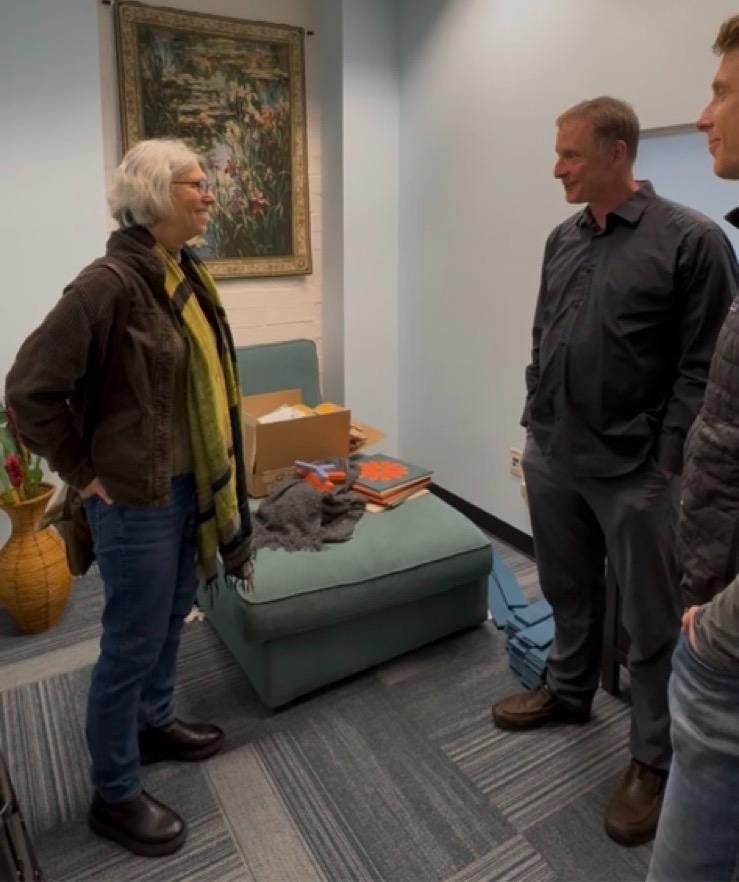
I recently sat with Toueg and Silver, who shared details of the study.
Forty healthy older adult volunteers, ages 60-85, will perform a battery of tests looking at memory, emotion and perception while their brain structure and function is measured using various MRI techniques. Then, after two preparation sessions, they will have a facilitated psilocybin experience. At one week and one month later, they’ll perform the same series of tests to measure any differences.
Promoting healthy aging
Toueg came to Berkeley with a background in the neuroscience of aging and Alzheimer’s disease. At a certain point he realized that, despite significant advances in early detection, if a 40-year-old is told she’s at high risk of developing Alzheimer’s, the advice she’ll get will still be the same – to exercise, sleep and socialize. That’s when he recognized the acute need for innovation in interventions to promote healthy aging.
When he read the studies showing that psychedelics ca n stimulate neural connections in parts of the brain that typically deteriorate during aging, that got him thinking.
“One of the things I’m interested in seeing in the brain imaging is whether we can actually measure these potentially beneficial changes of a psilocybin experience in older adults.”
As Toueg explains, there’s a lot of overlap between the conditions and behaviors that psychedelics influence and those associated with successful aging.
Depression, anxiety, stress, rumination are considered bad for aging. But things like awe, purpose in life, feeling socially connected, and being stable enough to regulate your emotions are all associated with healthier aging. And it seems like psychedelics, broadly speaking, reduce the bad stuff and increase the good stuff…”
An Alzheimer’s reality check
When it comes to psychedelics and Alzheimer’s, until now the only intervention of note has been to address the depression that accompanies a diagnosis of the disease. And for all the talk of their neuroplasticity-promoting and anti-inflammatory properties, at this point, any role of psychedelics as an actual treatment after the disease has progressed seems speculative at best.
As Toueg notes, “I’m a little pessimistic about the idea of taking people with Alzheimer’s disease and reversing their symptoms with something like psychedelics.”
Even if brain changes are detected after a psilocybin experience, he goes on to clarify, that won’t necessarily translate into improvements in memory. “This is more about improving our understanding of how to promote healthy aging and potentially reduce the risk of Alzheimer’s disease from developing in the first place.”
A dearth of data
Until recently, older adults have been routinely excluded from psychedelic clinical trials. As a result, there is very little validated data on safety and efficacy of these drugs in the older adult population.
The INSPIRE study, with its focus on physiological and psychological changes caused by psychedelics in older adults, will go a long way towards filling that gap. The UCB PLASTICITY study approaches the subject from a different angle, aiming to illuminate mechanisms of action of psilocybin, especially in the aging brain.
Years in the making
It’s taken almost four years to get the study off the ground, in large part due to the challenges of working with psilocybin, which is a Schedule I controlled substance. Silver estimates that at least ten times more overhead was involved compared to other research projects in his lab, where pharmaceutical drugs are administered to participants.
But on the positive side, the study is leveraging that initial investment, bringing together a distinguished, multidisciplinary team of principal investigators, each of whom will be gathering data as part of their collaborative research. Silver will be looking at how psilocybin affects visual perception of ambiguous stimuli , and Jagust, to changes in neural structure and function in older brains. UCB psychology professor Dacher Keltner and postdoctoral researcher Tyrone Sgambati will study how psilocybin affects the volunteers’ response to content designed to elicit feelings of awe. And UCSF professor Brian Anderson, a leading researcher on psychedelics in palliative care, is serving as medical director for the study.
A larger shift afoot
After our meeting, I emerged onto the rainy streets of Berkeley feeling incredibly optimistic.
When more leading researchers and young scientists are committed to studying psychedelics in older age, perhaps that reflects a larger shift in the zeitgeist around these medicines?
One thing is certain - with each new study, a clearer picture is emerging to support the auspicious matching between psychedelics and healthy aging. And as importantly, they should provide essential safety information to protect older psychonauts on their late-life journeys as well.
Healing Advocacy Fund featured an interview with me in their latest newsletter - scroll down to the Community Spotlight. Interesting questions….
good ton know !!
Totally agree we are at a moment . . .
Don't see the interview or the Community Spotlight section??